Background
History of the sugar industry
The development of sugar manufacture in the region, and how the modern industry took shape.
Details elaborated by the Greek historian Herodotus “the father
of history” It was the major expansion of the Arab peoples in the seventh century
AD that led to a breaking of the secret. When they invaded Persia in 642
AD they found sugar cane being grown and learnt how sugar was made. As
their expansion continued they established sugar production in During the Muslim Agricultural Revolution, Arab entrepreneurs adopted the techniques of sugar production from India and then refined and transformed them into a large-scale industry. Arabs set up the first large scale sugar mills, refineries, factories and plantations. Sugar was only discovered by western Europeans as a result of the Crusades in the 11th Century AD. Crusaders returning home talked of this "new spice" and how pleasant it was. The first sugar was recorded in England in 1099. The subsequent centuries saw a major expansion of western European trade with the East, including the importation of sugar. It is recorded, for instance, that sugar was available in London at "two shillings a pound" in 1319 AD. This equates to about US$100 per kilo at today's prices so it was very much a luxury.
Dutchman Dr. Willem Floor quotes in his book from the diaries and log
books of the captains of Dutch Vessels belonging to the Dutch East India
Company sailed in the The 1390s saw the development of a better press, which doubled the juice obtained from the cane. This permitted economic expansion of sugar plantations to Andalucia and to the Algarve. The 1420s saw sugar production extended to the Canary Islands, Madeira and the Azores. The Portuguese took sugar to Brazil. Hans Staden, published in 1555,
writes that by 1540 Santa Catarina Island had 800 sugar mills and that
the north coast of Brazil, Demarara and Suriname had another 2,000. During the eighteenth century, sugar became enormously popular and the
sugar market went through a series of booms. As Europeans established
sugar plantations on the larger Caribbean islands, prices fell, especially
in Britain. By the eighteenth
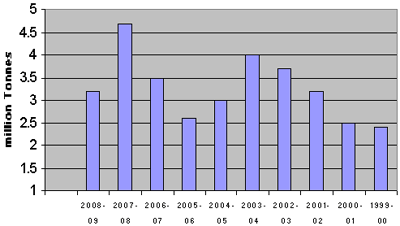
Source:- International Sugar Organization Oct 2009, By 1750 there were 120 sugar refineries operating in Britain. Their combined output was only 30,000 tons per annum. At this stage sugar was still a luxury and vast profits were made to the extent that sugar was called "white gold". Governments recognized the vast profits to be made from sugar and taxed it highly. In Britain for instance, sugar tax in 1781 totalled £326,000, a figure that had grown by 1815 to £3,000,000. This situation was to stay until 1874 when the British government, under Prime Minister Gladstone, abolished the tax and brought sugar prices within the means of the ordinary citizen. |
||||||||||||||||||||||||||||||||||||||||||||||||||||||||||||||
| Trade and Economics | ||||||||||||||||||||||||||||||||||||||||||||||||||||||||||||||
Historically one of the most widely-traded commodities in the world, sugar accounts for around 2% of the global dry cargo market. International sugar prices show great volatility, ranging from around 3 to over 60 cents per pound in the past 50 years. Of the world's 180-odd countries, around 100 produce sugar from beet or cane, a few more refine raw sugar to produce white sugar, and all countries consume sugar. Consumption of sugar ranges from around 3 kilograms per person per annum in Ethiopia to around 40 kg/person/yr in Belgium. Consumption per capita rises with income per capita until it reaches a plateau of around 35 kg per person per year in middle income countries. Many countries subsidize sugar production heavily. The European Union, the United States, Japan and many developing countries subsidize domestic production and maintain high tariffs on imports. Sugar prices in these countries have often exceeded prices on the international market by up to three times; today, with world market sugar futures prices currently strong, such prices typically exceed world prices by two times. |
||||||||||||||||||||||||||||||||||||||||||||||||||||||||||||||
| Sugar Industry in Pakistan | ||||||||||||||||||||||||||||||||||||||||||||||||||||||||||||||
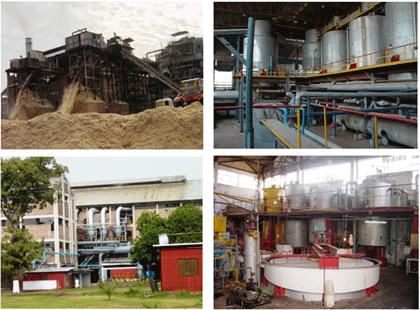
At the time of partition in 1947 only seven sugar mills, existed in the territories of Pakistan, 5 in East Pakistan now known as Bangladesh and only 2 in West Pakistan now known as Pakistan. These two sugar mills namely Rahwali Sugar Mills and Frontier Sugar Mills established in 1936 and 1938 had a capacity of 5000 tonnes each of producing white sugar. During 1954-56 three more sugar mills were established with a capacity of 10000-15000 tonnes. By 1955-56, the sugar production capacity in Pakistan was around 45,000 tonnes. With an abrupt change in the economic activities and urbanization, the demand for white sugar was on the increase. This was attributed to the manufacture of soft drinks, confectioneries and bakery products etc. The number of sugar mills was also on the increase to meet the demand.
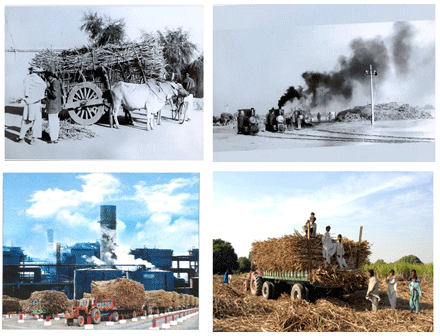
The system of supply of sugarcane to the mills has also revolutionized during these years from camel back and bullock carts to locomotives on narrow gage railway lines, tractor trolleys and now to large size trucks. Network of access roads financed and maintained with the help of road Cess Funds on sugarcane being collected from sugarcane suppliers and milers, modernized the supply line to sugar mills, few having reached now 12,000 tonnes crushing capacity per day, whereas sugarcane production is lacking behind due to low yield forcing the capacity utilization down to 50% in bad harvests.
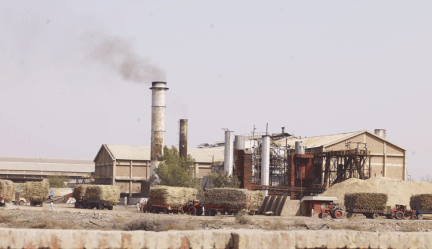
By 1980 there were 35 sugar mills in the country capable of providing 1.0 million tonnes. Ten more sugar mills were installed by 1990 with the production capacity having reached 2.0 million tonnes. Population and per capita increase always kept the demand high and number of sugar mills increased to 86 in 2009.
|
||||||||||||||||||||||||||||||||||||||||||||||||||||||||||||||
| Brief Features of the Sugar Industry | ||||||||||||||||||||||||||||||||||||||||||||||||||||||||||||||
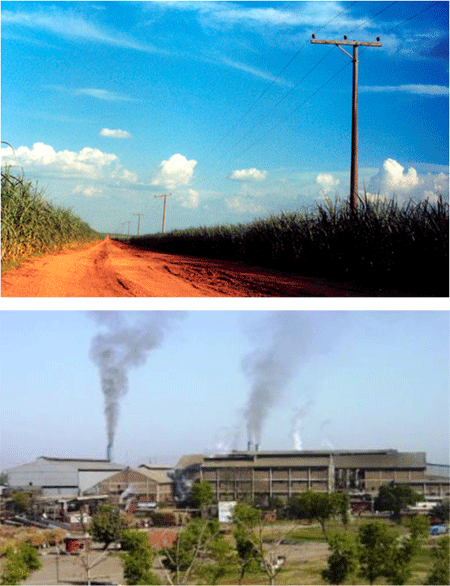
Pakistan is the sixth largest sugar producer in the world. Its 86 sugar
mills has the capacity of producing 7.0 million tonnes of sugar annually,
indeed with full capacity Being the second biggest agro-based industry, it is a source of revenue to the Government of Pakistan by about Rs. 22.0 billion, to the growers by Rs. 110-135 billion and to the vendors, other contractors, transporters and suppliers by about Rs. 20.0 billion, beside providing direct and indirect employment to 1.20 million people particularly in the rural areas of the country. In Pakistan’s under developed rural areas, establishment of a sugar mills is seen as a sign of prosperity to the area, as with a sugar-mill comes a new communication system, roads, colonies, schools, hospitals, electricity and above all fresh opportunities of trade and employment for every cadre of society. Thus the sugar industry is both economically and of strategic importance to the country. Its viability has been hampered by the governments’ imprudent policies made without prior consultation of the industry. This particularly applies to its sugarcane price-fixing policy. |
||||||||||||||||||||||||||||||||||||||||||||||||||||||||||||||
| Sugarcane Payment System | ||||||||||||||||||||||||||||||||||||||||||||||||||||||||||||||
The Government of Pakistan supports cane production by setting a market minimum support price announced before or after planting. The support price is set below the local demand price. As a result mills renegotiate the procurement price. The crop price increases up to 50% whenever the crop cycle is at its low ebb. The sugarcane support price has increased from Rs. 40/- per 40 kg in
2009-10 is yet to see another 25% increase in the support price of sugarcane in an effort of price incentive to the farmers for increase in plantation which will directly affect the existing production cost of sugar proportionately. Throughout the entire crushing season the price issue remains a volatile issue between the growers and the millers. The growers refuse to sell the cane at the official price and millers in some areas of Punjab and Sindh delay the start of crushing season. The milling sector ends up bearing the bulk of the risk when the circumstances change. While the support price varies significantly when there is shortfall during a particular harvest, there is no similar level of adjustment when the harvest is good and cane is in abundant supply. Further, this situation is exacerbated by untimely sugar imports contributing to the destabilization of domestic price, always under pressure due to fluctuating harvests.
Continued efforts are underway led by the Pakistan Sugar Mills Association to persuade the Government of Pakistan to consider adoption of a more reliable sugarcane payment system linking the price of cane with the sugar content as being used in Australia and other countries of the world, based on cane quality, a fair deal to growers and millers as well.
Unless such mechanism is not adopted in Pakistan further expansion in the production will remain in jeopardy while all potentials exist to improve yield and recovery and utilize the already built production capacity. The present system of increasing the sugarcane support price only encourages the farmer plantation expansion at the cost of other competitive crops that proves only temporary phase.
|
||||||||||||||||||||||||||||||||||||||||||||||||||||||||||||||
|
||||||||||||||||||||||||||||||||||||||||||||||||||||||||||||||
Purity |
||||||||||||||||||||||||||||||||||||||||||||||||||||||||||||||
Technicians usually measure the purity (sucrose content) of sugar by polarimetry — the measurement of the rotation of plane-polarized light by a solution of sugar. In past sulphur dioxide was bubbled through the cane juice before evaporation to bleach many colour impurities in to colourless. Sugar was bleached by this process was known as “SULPHITATION”. In Pakistan the sulphitation process has blurred off completely from the old mills the new technique of “CARBONATION” is adopted where sugar syrup is decolorized by filtration through a bed of activated carbon. Following are the requirements established by the Pakistan Standard Quality Control Authority (PSQCA) for the production of white sugar ps 1822-2007 R. some of the specified limits i.e. ICUMSA is considered as un-necessarily higher side for domestic consumption, which is still to be considered by the sugar industry. |
||||||||||||||||||||||||||||||||||||||||||||||||||||||||||||||
| Requirements for Refined Sugar and White Sugar at the time of Manufacture (Clause 2.3) |
||||||||||||||||||||||||||||||||||||||||||||||||||||||||||||||
|---|---|---|---|---|---|---|---|---|---|---|---|---|---|---|---|---|---|---|---|---|---|---|---|---|---|---|---|---|---|---|---|---|---|---|---|---|---|---|---|---|---|---|---|---|---|---|---|---|---|---|---|---|---|---|---|---|---|---|---|---|---|---|
|
||||||||||||||||||||||||||||||||||||||||||||||||||||||||||||||
| (P.S. 1822-2007 R revised version still to be published by PSQCA) | ||||||||||||||||||||||||||||||||||||||||||||||||||||||||||||||
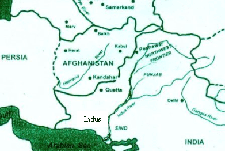 narrate that
great king of Persia Darius commissioned a navel party to explore the
River Indus to its mouth. Led by lonian Greek named Skylax the expedition
proceeded east and hit the Kabul River and then headed south to Arabian
sea, the outfall of River Indus. The mission was followed soon and in
510 BC the Emperor Darius of what was then Persia invaded India where
he found "the reed which gives “honey without bees". The
secret of cane sugar, as with many other of man's discoveries, was kept
a closely guarded secret whilst the finished product was exported for
a rich profit.
narrate that
great king of Persia Darius commissioned a navel party to explore the
River Indus to its mouth. Led by lonian Greek named Skylax the expedition
proceeded east and hit the Kabul River and then headed south to Arabian
sea, the outfall of River Indus. The mission was followed soon and in
510 BC the Emperor Darius of what was then Persia invaded India where
he found "the reed which gives “honey without bees". The
secret of cane sugar, as with many other of man's discoveries, was kept
a closely guarded secret whilst the finished product was exported for
a rich profit.  other
lands that they conquered, including North Africa and Spain.
other
lands that they conquered, including North Africa and Spain.  In the 15th century AD, European sugar
was refined in Venice, confirmation that even then when quantities were
small, it was difficult to transport sugar as a food grade product. In
the same century, Columbus sailed to the Americas, the "New World".
It is recorded that in 1493 he took sugar cane plants to grow in the Caribbean.
The climate there was so advantageous for the growth of the cane that
an industry was quickly established.
In the 15th century AD, European sugar
was refined in Venice, confirmation that even then when quantities were
small, it was difficult to transport sugar as a food grade product. In
the same century, Columbus sailed to the Americas, the "New World".
It is recorded that in 1493 he took sugar cane plants to grow in the Caribbean.
The climate there was so advantageous for the growth of the cane that
an industry was quickly established.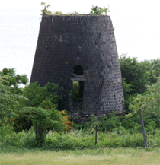 Thatta
(Sindh) as far as the 1700s to sell spices and food products. They purchased
leather, rice and textile etc. from Sindh. The diaries reveal that the
merchants could sell sugar sooner than other commodities at high profits
because the locally produced unrefined sugar called Gur would ferments
when stored from some time. according to their report sugarcane was grown
at that time around the Mancher Lake in Sindh.
Thatta
(Sindh) as far as the 1700s to sell spices and food products. They purchased
leather, rice and textile etc. from Sindh. The diaries reveal that the
merchants could sell sugar sooner than other commodities at high profits
because the locally produced unrefined sugar called Gur would ferments
when stored from some time. according to their report sugarcane was grown
at that time around the Mancher Lake in Sindh.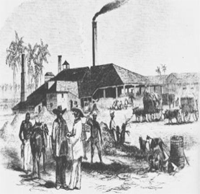 Approximately
3,000 small mills built before 1550 in the New World created an unprecedented
demand for cast iron gears, levers, axles and other implements. Specialist
trades in mold-making and iron-casting developed in Europe due to the
expansion of sugar production. Sugar mills construction developed technological
skills needed for a nascent industrial revolution in the early 17th century.
After 1625 the Dutch carried sugarcane from South America to the Caribbean
islands, where it became grown from Barbados to the Virgin Islands. The
years 1625 to 1750 saw sugar become worth its weight in gold. With the
European colonization of the Americas, the Caribbean became the world's
largest source of sugar. These islands could supply sugarcane using slave
labour and produce sugar at prices vastly lower than those of cane sugar
imported from the East.
Approximately
3,000 small mills built before 1550 in the New World created an unprecedented
demand for cast iron gears, levers, axles and other implements. Specialist
trades in mold-making and iron-casting developed in Europe due to the
expansion of sugar production. Sugar mills construction developed technological
skills needed for a nascent industrial revolution in the early 17th century.
After 1625 the Dutch carried sugarcane from South America to the Caribbean
islands, where it became grown from Barbados to the Virgin Islands. The
years 1625 to 1750 saw sugar become worth its weight in gold. With the
European colonization of the Americas, the Caribbean became the world's
largest source of sugar. These islands could supply sugarcane using slave
labour and produce sugar at prices vastly lower than those of cane sugar
imported from the East.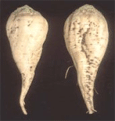 century
all levels of society had become common consumers of the former luxury
product. At first most sugar in Britain went into tea, but later confectionery
and chocolates became extremely popular. Suppliers commonly sold sugar
in solid cones and consumers required a sugar nip, a pliers-like tool,
to break off pieces.
century
all levels of society had become common consumers of the former luxury
product. At first most sugar in Britain went into tea, but later confectionery
and chocolates became extremely popular. Suppliers commonly sold sugar
in solid cones and consumers required a sugar nip, a pliers-like tool,
to break off pieces.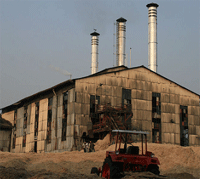 Beginning in the late
18th century, the production of sugar became increasingly mechanized.
The steam engine first powered a sugar mill in Jamaica in 1768, and soon
after, steam replaced direct firing as the source of process heat. During
the same century, Europeans began experimenting with sugar production
from other crops. Andreas Marggraf identified sucrose in beet root and
his student Franz Achard built a sugar beet processing factory in Silesia.
However the beet-sugar industry really took off during the Napoleonic
Wars, when France and the
Beginning in the late
18th century, the production of sugar became increasingly mechanized.
The steam engine first powered a sugar mill in Jamaica in 1768, and soon
after, steam replaced direct firing as the source of process heat. During
the same century, Europeans began experimenting with sugar production
from other crops. Andreas Marggraf identified sucrose in beet root and
his student Franz Achard built a sugar beet processing factory in Silesia.
However the beet-sugar industry really took off during the Napoleonic
Wars, when France and the  continent
were cut off from Caribbean sugar. Today 30% of the world's sugar is produced
from beets. The following countries mainly produce sugar from beet, though
some of these countries marked ** produce sugar from sugarcane as well.
continent
were cut off from Caribbean sugar. Today 30% of the world's sugar is produced
from beets. The following countries mainly produce sugar from beet, though
some of these countries marked ** produce sugar from sugarcane as well.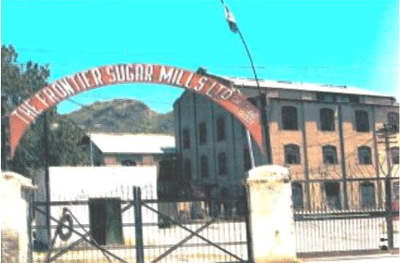 Though production and use of sugar
is recorded in 520 BC and long before, the growth of the modern form of
white sugar industry in the Indian Sub-continent could be traced to early
‘30s. The number of sugar mills rose from 29 in 1931 to 139 in 1939.
World War II established the need and supply of the sugar as an important
commodity. While the European industrial base was being diverted to the
war machinery, Asia had the chance to improve its sugar industry and supplies
to war torn countries of Europe.
Though production and use of sugar
is recorded in 520 BC and long before, the growth of the modern form of
white sugar industry in the Indian Sub-continent could be traced to early
‘30s. The number of sugar mills rose from 29 in 1931 to 139 in 1939.
World War II established the need and supply of the sugar as an important
commodity. While the European industrial base was being diverted to the
war machinery, Asia had the chance to improve its sugar industry and supplies
to war torn countries of Europe. 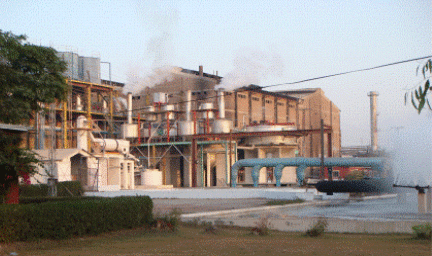
 utilization
that would need supply of 80 million tonnes of sugarcane, the best being
53 million tonnes in 2007-08. The surplus installed capacity is causing
concern particularly in low supply season. The total outlay at current
cost is US$ 1.50 billion. Present annual sugar consumption of the country
has crossed 4 million tonnes valued at US$1.8 billion.
utilization
that would need supply of 80 million tonnes of sugarcane, the best being
53 million tonnes in 2007-08. The surplus installed capacity is causing
concern particularly in low supply season. The total outlay at current
cost is US$ 1.50 billion. Present annual sugar consumption of the country
has crossed 4 million tonnes valued at US$1.8 billion.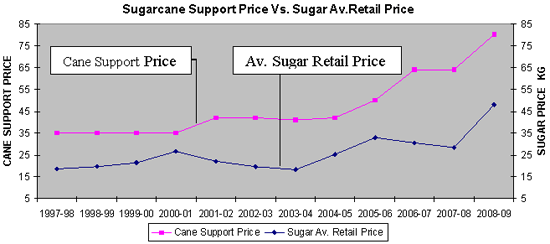
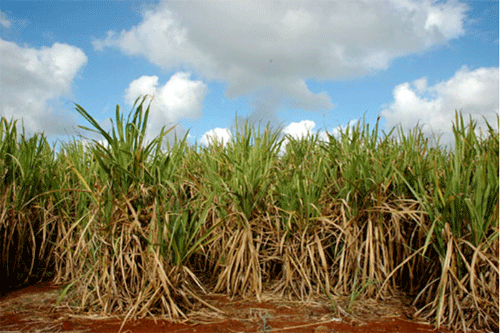
 At present in Pakistan sugarcane is
the only crop that gets paid by weight and not by quality. The system
does not provide for any incentive to the grower to improve his crop particularly
towards the most crucial aspect, the sugar content.
At present in Pakistan sugarcane is
the only crop that gets paid by weight and not by quality. The system
does not provide for any incentive to the grower to improve his crop particularly
towards the most crucial aspect, the sugar content.