Annual review
Annual Review 2004
The chairman’s review of the season as published by the association.
| Annual Review 2004 | ||||||||||||||||||||||||||||||||||||||||||||||||||||||||||||||
| Iskander M Khan | ||||||||||||||||||||||||||||||||||||||||||||||||||||||||||||||
| Dear Members: | ||||||||||||||||||||||||||||||||||||||||||||||||||||||||||||||
| Distinguished Members, I am pleased to present the Annual Report of the Pakistan Sugar Mills Association for the year ending 30th September’2004. This Annual General Meeting is being held at the conclusion of the two years term of the Chairman and the Central Executive Committee elected for the session 2002-04. The Association holds elections regularly for the Centre and the Zonal management, which is recently completed for the term 2004-06. The names of the newly elected Management for the term 2004-06 will be announced at the end of this meeting. I, now present you with the annual review and the general outlook of the industry. 2003-04: The year under review. Nature has been very kind to Pakistan during the year, bestowed it with
abundance availability of water at the right timings, with its major reservoirs
at a satisfactory level even at the end of winter, ensuring a regular
supply of water through our irrigation system. In addition, the periodic
rains at desired timings had a favourable effect on the crops particularly
the sugarcane, the most water-demanding crop. The production at this level confirm the following, claimed by the industry.
|
||||||||||||||||||||||||||||||||||||||||||||||||||||||||||||||
|
||||||||||||||||||||||||||||||||||||||||||||||||||||||||||||||
| Despite the favourable conditions the year neither brought due economic
benefits to the growers nor the millers. With the addition of carryover
stock, the total availability rose to 4.76 millions tonnes, almost a million
tonne over and above the domestic consumption. Domestic sugar price was already on the downward slide in continuation of the past two years, whereby only half a million tonne surplus caused 20% crash in the domestic price. The negative prospect with over a million tonne surplus was clearly foreseen as predicted. Before the delayed commencement of crushing season 2003-04, the ECC held on 12th Nov’2003 decided to purchase 200,000 tonnes of sugar through TCP in two tranche as a strategic stock, in exportable specification and packing, replaceable with fresh sugar at the beginning of the new crushing season. Acknowledging a bigger harvest PSMA continued with a series of meetings
with the concerned Ministries, and finally had to communicate the situation
to the PSMA was put in a very difficult situation and had to offer the desired commitment after few days for the obvious reasons. Growers arrear has always been a matter of concern to the Government as well the industry. Government’s pressure to start early crushing goes to favour few farmers is worth re-consideration. Production 2003-04 is credited to multiple positive growths in the sugarcane crop and delayed commencement of crushing season that resulted in recovery improvement by 0.41%, which enhanced the production; otherwise this would have been partially wasted. Early start of the crushing is always forced at the cost of recovery loses to vacate a small portion of land for the late wheat sowing. This year again Sindh Government through a notification has directed the mills to start as early as 1st week of October based on the shortage of water supply and to add the land for the wheat sowing. The real impact of such forcible actions needs to be evaluated for a balanced decision. As per decision of the Government, 465,095 tonnes was procured by the TCP through tenders exclusively from PSMA members and to be stocked at the mills godowns. Another 20,000 tonnes was lifted to complete the procurement made last year for 100,000 tonne export.
These recommendations were well received and hopefully are being processed by the Ministry of Industries and Production.
response to the Ministry of Commerce call for items on sensitive list, PSMA responded with a request to include “Sugar” on the list of sensitive items. At the end of July 04, based on the biased media reporting, the Government announced the sale of sugar from the TCP’s reserve stock to control the so called rise in the sugar retail price, whereas, in reality, the retail market price during the months of June and July did not show any alarming fluctuation. Government must consider that the industry has been through a long period of crises, and minor fluctuation in the market prices does not require decisions having long-term adverse implications. Recently the ECC in its decision of 21st September 04, directed TCP
to release 200,000 tonnes of sugar from the buffer stock to stabilize
sugar prices during the Holy month of Ramzan. While take up the decision
PSMA was not consulted, and did not account for the stock availability
with the mills and in the market. The retail market price of Rs. 20/62
per kg was recorded in August 04 that did not require the GOP to release
the TCP’s buffer stock. This move has depressed the ongoing sale
from the mills, especially at the time when mills are making preparation
to commence the upcoming crushing season. Outlook 2004-05 Preliminary report from MINFAL indicates that sugarcane for the year 2004-2005 is cultivated on 949,700 hectares, which is 11.63% lower compared to the last year’s area under sugarcane plantation. In 1998-99, the sugarcane plantation area was 1,155,200 hectares at maximum. Apparently, the sugarcane production has decreased as the water supply has not been as good as that of last year, as the winter rains
have been below average and monsoon’s arrival was late. Last year,
the yield had improved to over 50.0 tonnes per hectare, which is now estimated
at 47.5 tonnes per hectare, that may yield The carry over stock at the mills along with the TCP’s owned stock
would make availability to around 4.0 million tonne against estimated
consumption of 3.6 million tonne. Hence enough stocks are ensured for
the year 2004-05, and therefore any significant price hike is not foreseen.
Our policy makers are advised to realize that the millers and the growers both need to have positive incentives, as very soon, the consumption in Pakistan will catch up with the production in the country. In the near future the period of distorted international prices will also be over in stages. Once the international sugar prices are free of subsidies and other barriers, the import business is going to be very costly and soon our economists will harp the viability of our sugar industry, who have been advising otherwise negatively The present over sensitiveness on the slight increase in the sugar prices is harming the industry and the growers both and it is not doing any good to the priority stakeholder i.e. the consumer whose total sugar consumption expense in the house hold budget is maximum up to 2.0 % in the lower middle class, and is further reduced in the upper class. Farmers and Millers of the developed countries already had the leading
advantage of the subsidies for many years, while the developing countries
curbed the subsidies with loyalty and inhibited the domestic industry
to invest in research and development for achieving scientific growth
by the growers. Immediate attention is desired for a countrywide campaign
towards meaningful research and development on the cane varietal improvement
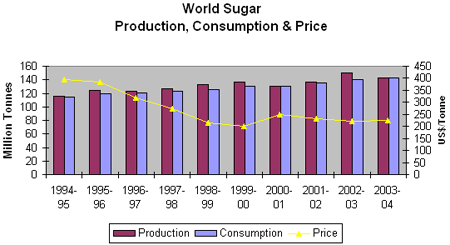
and productivity of the mills to meet the future challenges. Various international agencies have been giving different production and consumption estimates for the year 2003-04 ranging from 145.0 to 140.0 million tonne on production side and 145.0 to 139.0 million tonne on consumption, more or less a balance year. With the support of heavy carry over stocks, the prices remained fluctuating within a low range of anxiety. The nervousness of the world market at the year’s end was obvious as it approaches the end of long series of surplus years and the deficit widely predicted for the coming crop cycle at the global level.
World production and consumption for the year 2004-05 has been generally forecasted as minor deficit by the most global agencies. India faced a severe short fall but prices remained stable due to of huge carry over stock of 13.5 million tonnes. Drought conditions are improved due to recent rains and with the support of adequate carry over stock India may not be active in the international market. China is impressively improving on the consumption side by control on saccharin by the food industry. To meet the demand Government is releasing sugar from the state reserves. In Russia, imports are controlled by a combination of lower import duty in (May-July) fixed at US$ 206/- per tonne and US$ 235/- in April. The prevailing wholesale prices have recently reached US$ 560/- per tonne. For large size imports the country may reappear in the market. However, taking into account the gradual return to the normal stock position globally, the outlook seems positive. The tight production and supply worldwide indicates higher prices next year. WTO is already examining the claim forwarded by Australia, Brazil and Thailand against the European Union that brought the international sugar market down by illegal subsidies. The distorted prices have adversely affected the developing countries like Pakistan who could not afford to export its surplus production. Due to the special and differential treatment the safeguard measures did not work in favour of the developing countries. On 1st & 2nd August’2004 after a marathon negotiation in Geneva,
the key WTO members agreed and struck a crucial deal to slash the multi-billion-
dollar farm subsidies and open industrial market to boost global trade.
The accord could lift poverty and trigger growth in many poor and developing
countries. The decision includes sweeping changes to the long standing
heavily subsidized production and marketing system, which distorted the
global sugar prices. Conclusion
In the end of the annual review I wish to register my thanks to all our Zonal Chairmen, members of our Central and Zonal Committees and specially to the Secretary General Mr. Qazilbash with whose co-operation and team work spirit we were able to convince Government of Pakistan to provide a short term relief. We hope to continue with the same co-operation as the new management takes charge. |
||||||||||||||||||||||||||||||||||||||||||||||||||||||||||||||
|
||||||||||||||||||||||||||||||||||||||||||||||||||||||||||||||